


In highly energy-efficient buildings, several technologies are used to meet the KfW Efficiency House 40 standard or comparable energy efficiency classes. Integrated systems that provide electricity, heating, and cooling reliably, quietly, and cost-effectively are currently trending. Modern energy systems are designed to ensure a steady supply even when space is limited and without reliance on geological resources.
One particularly promising approach is called trigeneration. The term refers to an energy system consisting of PVT collectors, a heat pump, and an ice storage unit. The system builds on the concept of ice storage solutions, which are well-known and proven in practice: simple in design, technically sophisticated, and modularly expandable. A trigeneration system is of interest to planners, project developers, municipalities, and investors seeking a future-proof solution for sustainable heating and cooling systems. Trigeneration can be scaled from individual buildings to entire neighborhoods.
How Does Trigeneration Work, and What Is Its Potential?
1. A New System Approach for the Building Sector
The growing demand for sustainable heating and, above all, cooling technology calls for new, energy-efficient system approaches. Individual technologies such as photovoltaics, heat pumps, and ice storage are now well established. Integrating these technologies into a single energy system promises significant additional efficiency gains. Such a trigeneration system represents a decisive step toward greater sustainability in the building sector.
Trigeneration does not aim for the incremental development of existing individual systems, but rather for a new, holistic energy system that considers and controls electricity, heat, and cooling together. The focus is not on individual components, but on the interaction of all system components. The design is based on the criteria of efficiency, operational reliability, and long-term cost-effectiveness.
2. The System Components: Trigeneration Using PVT, a Heat Pump, and Ice Storage
The trigeneration system is based on the fundamental principle: one energy source—multiple uses. Solar energy, environmental energy, and electrical energy are combined into a single, integrated system. The three core components are designed to work together from the outset:
- PVT collectors supply electricity and usable heat
- Heat pumps combine electricity, heat, and cooling
- Ice storage systems function as thermal batteries
The interaction of these three components enables a new level of system performance that goes far beyond the simple sum of the individual technologies.
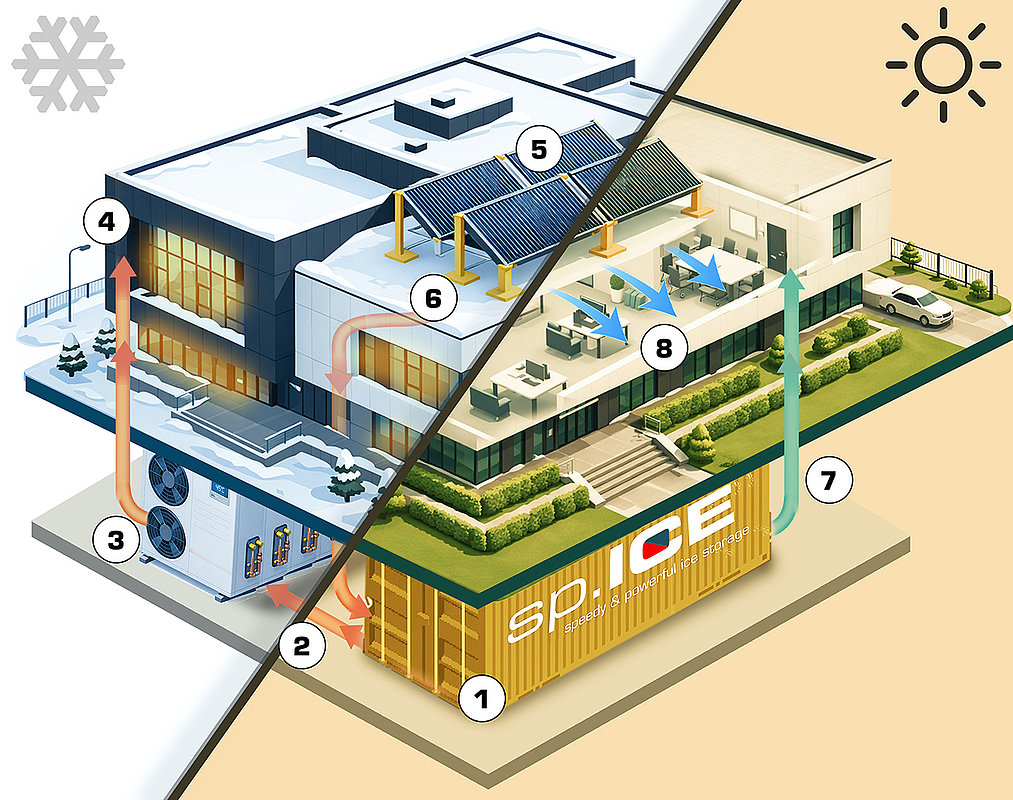
Winter
1 sp.ICE Ice Storage Tank
In winter, the ice storage tank serves as the heat source for the heat pump
2 Heating Mode
The heat pump extracts energy from the ice storage tank to supply the building with heating and hot water
3 Heat Pump
4 Hot Water Pipes
5 Ambient Heat
Heat from the sun or the air is harnessed via the PVT elements to charge the ice storage tank
6 Ice Storage Tank Regeneration
Ambient heat prevents the ice storage tank from freezing completely, ensuring efficient, continuous operation
Summer
7 sp.ICE Ice Storage Tank in Summer
In summer, the ice storage unit serves as a cooling source
8 Cooling Operation
The charged ice storage unit ensures building air conditioning in summer without the need for additional chillers
During the warm months, the ice in the ice storage unit melts. Starting in the fall, the ice storage unit once again supports heating operations.
3. Why PVT instead of PV?
PVT stands for photovoltaic-thermal systems. PVT collectors use absorbers on the back that transfer the generated heat to a fluid. Removing this heat also increases the efficiency of the solar modules. While conventional photovoltaic systems generate only electricity, PVT collectors generate both electricity and heat.
For this reason, PVT is ideally suited for use in systems with heat pumps and ice storage. Technical advantages:
- higher electrical output through cooling of the PV cells
- additional low-temperature heat for the heat pump
- better overall utilization of available roof or facade space
- stable system temperatures and quiet operation
Result: PVT not only supplies electricity and heat but also improves the efficiency of the heat pump. This is particularly true for systems combined with an ice storage unit.
4. Ice Storage as a Thermal Battery
The ice storage system stores energy not as hot water, but in the form of ice. The phase change from water to ice results in an extremely high storage density. This offers advantages over conventional heat storage systems and geothermal energy:
- 5–7× higher energy density than water
- constant cooling temperatures of 0–6°C
- No drilling required, no geological surveys, no permitting risks
- Ideal for urban locations and retrofits
- Fully measurable and controllable
5. Operating Modes – Efficiency in Every Situation
Active Operation
- PVT supplies electricity and heat
- Heat pump operates with higher efficiency (COP)
- Simultaneous generation of heat and cooling
Passive cooling mode
- Cooling directly from the ice storage tank
- No compressor, minimal power consumption
- Ideal for summer and peak loads
Winter and peak load operation
- Ice storage stabilizes the heat pump at very low outdoor temperatures
- Reliable efficiency even during heating peaks
6. Smart Energy Management
As is typical for modern ice storage systems, the trigeneration system is also centrally monitored and controlled. The energy management system ensures coordinated operation of all components:
- On-site use of solar power
- Demand-based operation of the heat pump
- Targeted charging and discharging of the ice storage tank
- Reduction of peak loads and operating costs
The result is a robust, transparent, and easily planable energy system that integrates seamlessly into existing building management systems.
7. Typical Areas of Application (B2B)
- Hotels & Resorts
- Office and Commercial Real Estate
- Industrial & Manufacturing Sites
- Hospitals & Care Facilities
- Residential Neighborhoods & District Heating
- Municipal Buildings
8. Economic and Environmental Benefits
- Very high share of renewable energy
- Drastic reduction in CO₂ emissions
- Lower operating costs
- Shorter payback periods
- Lower investment risk than geothermal energy
- Modular and expandable
9. Why a New System Concept Is Necessary
The requirements for modern buildings have changed fundamentally:
- Today, cooling is just as important as heating
- Electricity prices and grid utilization fluctuate significantly
- Space for energy generation is limited
- Permitting and noise requirements are increasing
The presented trigeneration system addresses these challenges not with individual measures, but with a systemic approach in which all energy flows are optimized collectively.
Conclusion:
Trigeneration with PVT, a heat pump, and ice storage combines proven technologies into a holistic energy system. The approach follows the same principles that have already been established in ice storage solutions: clear functionality, high efficiency, and flexible application options. For commercial and municipal applications, the system offers a future-proof alternative to conventional heating and cooling solutions—without drilling, without complex permitting processes, and with a high proportion of renewable energy.
Comments (0)
Be the first to comment